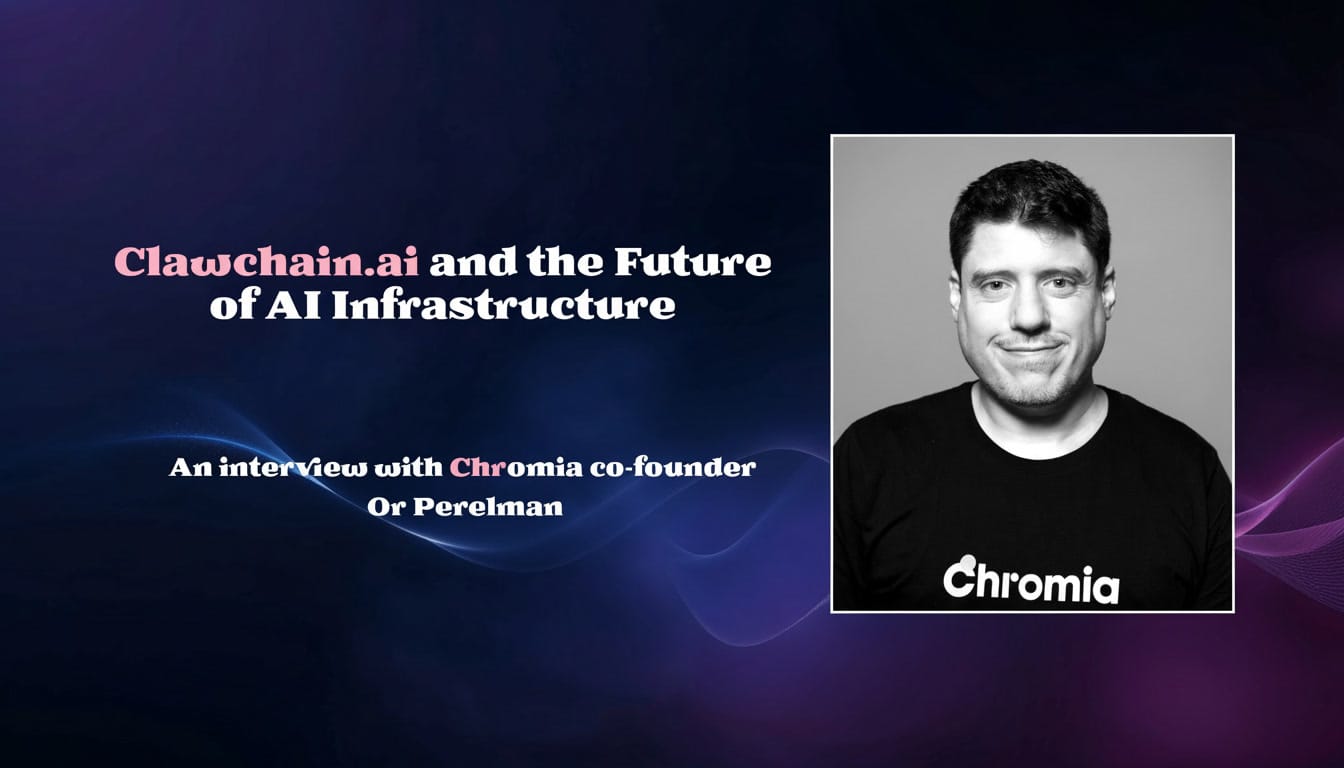
Clawchain.ai and the Future of AI Infrastructure: An Interview with Or Perelman
As artificial intelligence rapidly evolves beyond simple tools into autonomous digital agents capable of making decisions and executing tasks, the infrastructure supporting these systems is becoming an increasingly important conversation in the technology industry.
Clawchain.ai is a newly launched platform designed to provide blockchain-powered infrastructure for AI agents, enabling them to interact, transact, and collaborate within verifiable environments.
In this interview, we speak with Or Perelman, CEO of Chromia and creator of Clawchain.ai, about the inspiration behind the project and how AI agents could reshape the digital economy.
What inspired the creation of Clawchain.ai?
Over the past few years, we’ve seen an explosion in the capabilities of artificial intelligence. What started as tools that assist humans are quickly evolving into autonomous agents that can execute tasks, interact with services, and even coordinate with other systems.
The challenge is that once you have autonomous systems operating at scale, the questions of trust, accountability, and coordination become critical. How do you verify what an AI agent has done? How do multiple agents collaborate without relying on centralized systems?
Clawchain.ai was created to address those questions by combining the transparency of blockchain with the intelligence of AI systems.
AI agents are becoming a major trend. What challenges does the industry face?
AI agents introduce a fundamentally new dynamic in the digital world. Instead of humans directly interacting with software, we now have software interacting with other software autonomously.
That creates several challenges. One is verification — ensuring that the actions performed by an agent are legitimate and traceable. Another is identity — how agents establish trusted identities when interacting with other systems.
Without infrastructure designed for these challenges, large-scale coordination between autonomous systems becomes very difficult.
Many people see AI and blockchain as separate industries. Why do they need to converge?
Blockchain provides something that AI systems currently lack: a transparent and verifiable execution layer.
If AI agents are going to perform tasks such as executing transactions, accessing services, or coordinating complex workflows, there needs to be a way to verify those actions. Blockchain technology offers a mechanism to record and validate those interactions without relying entirely on centralized control.
The convergence of these two technologies creates a powerful foundation for autonomous digital systems.
In simple terms, what does Clawchain.ai do?
Clawchain.ai provides infrastructure that allows AI agents to operate within a verifiable digital environment.
Through the platform, agents can establish identities, interact with applications, and perform actions that are recorded and validated on-chain. This creates a system where interactions between agents, applications, and services can be transparent and trusted.
Our goal is to provide developers with the tools they need to build intelligent systems that can operate securely and collaboratively.
Who is Clawchain.ai designed for?
Primarily for developers building AI-driven applications, but also for organizations exploring autonomous digital services.
As AI agents become more capable, we expect them to power everything from automated research tools and digital service assistants to decentralized marketplaces and collaborative networks of intelligent systems.
Clawchain.ai is designed to be the infrastructure layer that enables these kinds of applications.
How do you see the AI agent ecosystem evolving?
We are moving toward a world where AI agents become participants in the digital economy.
They will research information, execute workflows, interact with services, and collaborate with other agents. When that happens, the infrastructure supporting those interactions becomes extremely important.
We believe the next phase of AI development will focus not just on intelligence, but also on coordination, transparency, and trust.
What does success look like for Clawchain.ai?
Success for us means enabling developers to build new categories of applications that weren’t previously possible.
If Clawchain.ai becomes a foundational infrastructure layer that supports large-scale ecosystems of AI agents interacting across digital environments, then we will have achieved what we set out to do.
The long-term vision is a world where intelligent systems can collaborate and transact in ways that are transparent, verifiable, and open.
As artificial intelligence continues to evolve, the role of autonomous systems in the digital world is expanding rapidly. What were once experimental tools are increasingly becoming agents capable of performing tasks, coordinating workflows, and interacting with services on behalf of users.
For the team behind Clawchain.ai, this shift represents more than just a technological trend. It signals the emergence of a new digital environment where intelligent systems must be able to operate with transparency, accountability, and trust.
If AI agents are destined to become active participants in the global digital economy, the infrastructure supporting them will be just as important as the intelligence that powers them. Clawchain.ai is positioning itself as one of the platforms aiming to support that future — where autonomous systems can interact, collaborate, and transact in ways that are verifiable and open.
About Chromia
Chromia is a Layer-1 relational blockchain platform that uses a modular framework to empower users and developers with dedicated dapp chains, customizable fee structures, and enhanced digital assets. By fundamentally changing how information is structured on the blockchain, Chromia provides natively queryable data indexed in real-time, challenging the status quo to deliver innovations that will streamline the end-user experience and facilitate new Web3 business models.